Comfort, with context
Weighted stuffed animals and comfort plush
A heavier toy can feel different from ordinary stuffing. That feeling does not prove a treatment works. This guide helps adults and carers of older children compare fillings, understand weight guidance, and read the evidence.
Reviewed on 28 October 2026.
What gives a plush its weight?
Fillings differ between products. The manimo Lizard specification lists polyethylene beads inside a polyester and polyurethane exterior. Warmies lists flaxseed and dried French lavender. These manufacturer pages describe their own products, not every weighted toy (accessed 2026).
Check the filling, seams, care label, and intended age before choosing a toy. Think about whether you want a washable cover, an unscented filling, or a shape that rests comfortably on your lap. A familiar soft toy without added weight is also an option.
Do not assume that a weighted toy tolerates heat or immersion. Warmies says water can swell its seed filling and damage the product. It recommends surface cleaning. Follow the instructions for the exact product. A removable cover does not mean the filling is washable.
Free interactive tool
Weighted plush size helper
Enter body weight to explore the commonly cited blanket range. This comparison does not identify a safe plush weight. A plush can concentrate weight over a smaller area than a blanket. Do not buy a toy solely from this result.
The tool accepts 0.1–1,000 in the selected unit. These are input limits, not medical limits.
Method: body weight × 5% to body weight × 10%, in the same unit. Results round to three decimal places. Earth Blankets publishes this blanket guidance (accessed 2026). It is a sizing convention, not a clinically validated plush dose. The studies below do not establish a plush weight rule. Educational tool, not medical advice.
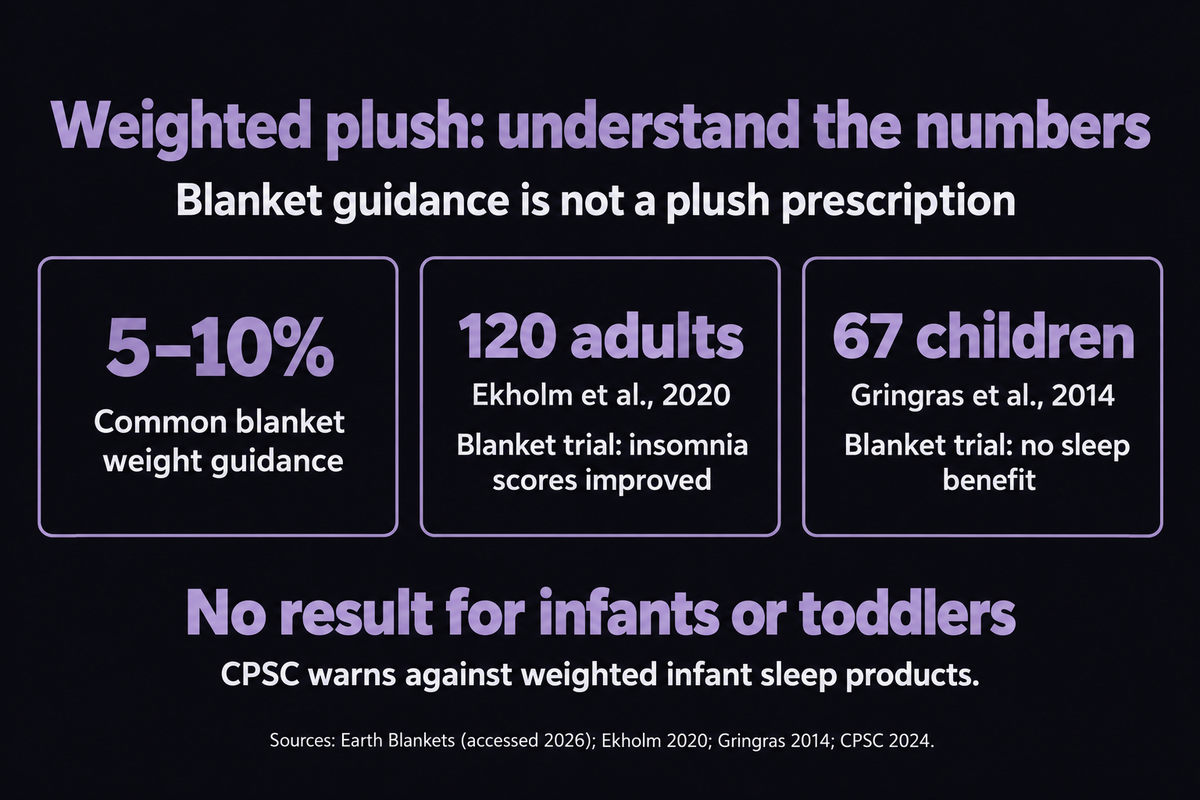
The helper blocks infants and toddlers. CPSC warns against weighted infant sleep products (2024). The toddler block is an additional site precaution, not a CPSC age threshold. Never use this calculation to justify an infant sleep product.
What does the evidence show?
Ekholm and colleagues (2020) randomized 120 adults with insomnia and psychiatric diagnoses to weighted metal chain blankets or light plastic chain blankets. After four weeks, the weighted group reported a greater improvement in insomnia severity. The result concerns that patient group and those blankets.
Gringras and colleagues (2014) randomized 73 autistic children with severe sleep problems. The analysis included 67 who completed the study. Each child used a weighted blanket and a control blanket for two weeks each. The weighted blanket did not improve measured sleep duration, sleep onset, or waking. Children and parents nevertheless preferred it.
Preference and treatment benefit are different outcomes. Neither study tested a stuffed animal. Our interpretation: these results cannot establish that a plush treats anxiety, releases particular hormones, or improves sleep. A pleasant sensation can still matter to someone without proving any of those claims.
Before an adult or older child uses one
The Royal College of Occupational Therapists (RCOT, 2023) identifies breathing and removal risks in blanket use. We apply these precautionary checks when considering plush.
Read the product instructions with the person who will use it. Ask whether they want added weight. Check that they can move the toy away without help. Stop if they feel discomfort or cannot move freely. Ask a clinician about suitability when breathing, movement, or communication is difficult.
For an older child, discuss the exact toy and intended use with a qualified professional. Do not treat a percentage as permission for sleep use. Product design and placement matter. The manimo manufacturer advises adult supervision for children (accessed 2026).
CPSC’s Safe Sleep guidance says to avoid weighted blankets and weighted swaddles for infants. It also advises a bare sleep space without soft objects (accessed 2026). A comfort toy does not belong in an infant sleep space.
Keep a simple note of comfort, ease of removal, and any unwanted effects. Persistent sleep problems deserve clinical assessment. Do not increase the weight to chase an advertised benefit.
Sources and reading
Manufacturer information supports filling and care details. The original trials support the study summaries. Plain source addresses follow.
- Earth Blankets, sizing guidance (accessed 2026). earthblankets.com
- manimo, Lizard specification and use (accessed 2026). manimo.ca/products/lizard-weighted-plush
- Warmies, care FAQ (accessed 2026). warmies.com/pages/faq
- Ekholm et al., Journal of Clinical Sleep Medicine (2020). doi:10.5664/jcsm.8636
- Gringras et al., Pediatrics (2014). doi:10.1542/peds.2013-4285
- RCOT, weighted blanket guidance (2023). rcot.co.uk/media/649/download
- CPSC, Commissioner Trumka’s weighted infant product statement (2024); Safe Sleep guidance (accessed 2026). cpsc.gov/SafeSleep